Vintiik
Pricing Calculator
Built mainly for dealers of vintage furniture, antiques, art, collectibles and other unique inventory. Enter your costs, set your target profit or margin, evaluate customer offers, compare the VAT Margin Scheme with Standard VAT, and calculate the right selling price.
Margin and markup are often confused, but they measure different things.
Margin is the percentage of the selling price that becomes profit.
Markup is the percentage added on top of your costs to reach the selling price.
For example, if an item costs €100 and sells for €150:
- Profit: €50
- Markup: 50%
- Margin: 33.3%
Most retailers use margin to measure business performance, while markup is commonly used when setting prices.
Start by calculating your total cost, including the purchase price, transport, restoration, platform fees, payment fees and any other direct costs.
Next, choose your target profit, margin or markup. Your final selling price should cover all costs while leaving enough profit to support your business.
Researching comparable sold items can also help, but every reseller has different costs. A good pricing strategy should be based on your own business rather than copying competitors.
The VAT Margin Scheme allows eligible second-hand goods dealers to pay VAT only on the profit margin instead of the full selling price.
For example, if you buy an item for €500 and sell it for €900, VAT is calculated only on the €400 margin, not on the full €900 sale.
The exact rules vary by country, so always check your local tax regulations or speak with your accountant before using the scheme.
Under Standard VAT, VAT is added to the selling price and collected from the customer.
For example, if your selling price is €1,000 excluding VAT and your VAT rate is 24%, the customer pays €1,240 including VAT.
Businesses registered for VAT can usually reclaim VAT on eligible business purchases, while private consumers pay the full VAT-inclusive price.
There is no single correct margin because every business has different costs.
Many resellers target 30–50% gross margin, while businesses with higher restoration, storage or marketing costs may require even more.
Instead of copying someone else's margin, calculate your own costs first. A healthy margin is one that consistently covers your operating expenses while leaving enough profit to grow your business.
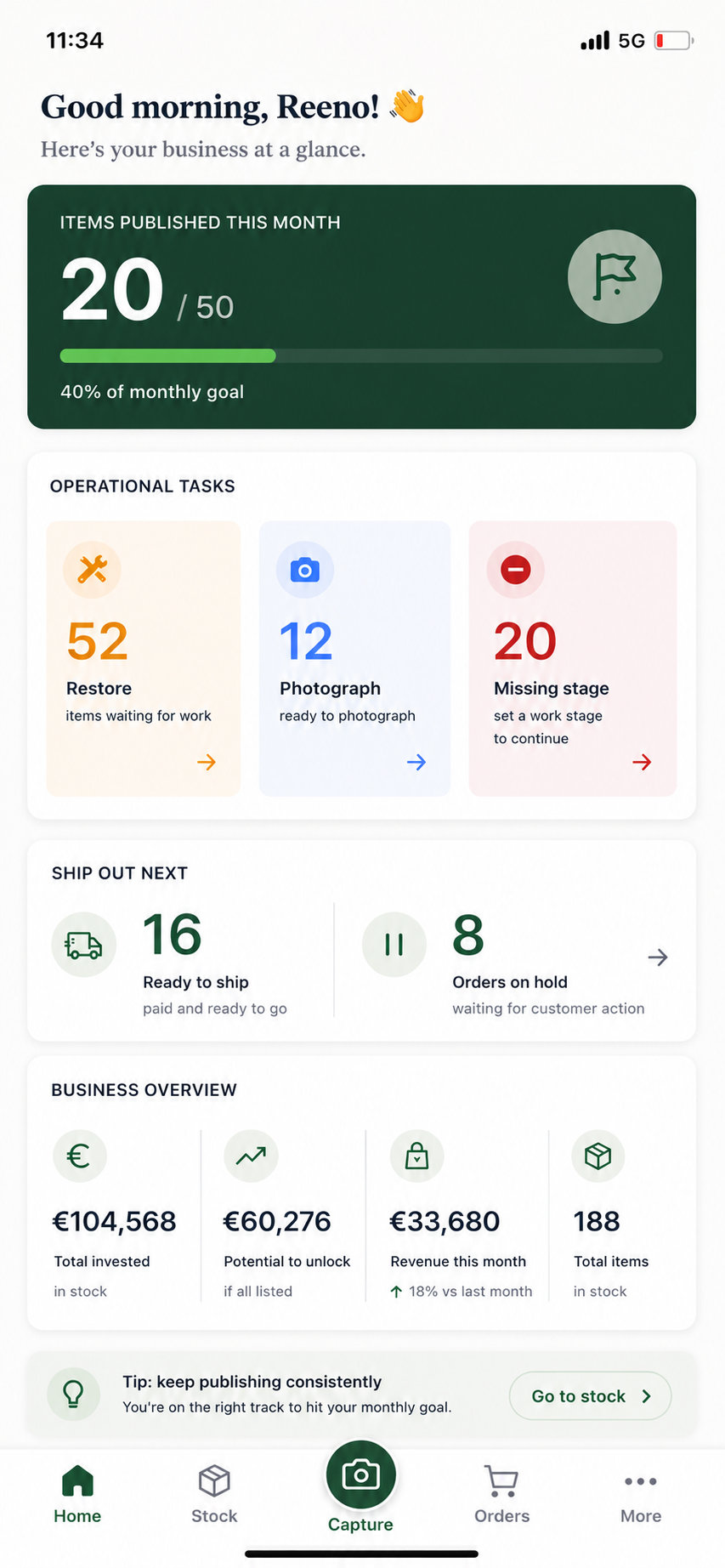
Managing unique inventory should be easier.
We're building faster workflows to help sellers capture, prepare, publish and manage every unique item — so it gets online faster.
Get early access to our tools.